Touch Recipe Book

Recipe for Mummification

A plant oil – possibly sesame oil;
A “balsam-type” plant or root extract that may have come from bullrushes;
A plant-based gum – a natural sugar that may have been extracted from acacia;
crucially, a conifer tree resin, which was probably pine resin

When mixed into the oil, that resin would have given it antibacterial properties, protecting the body from decay.

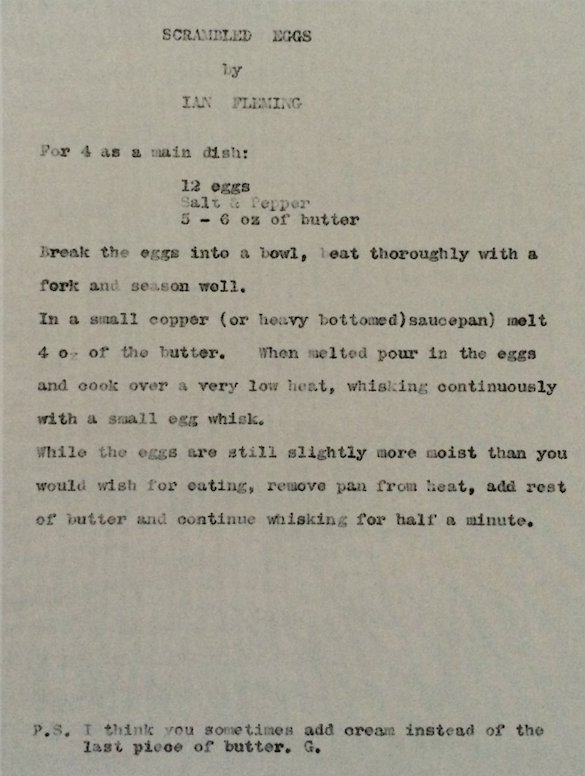
Ian Fleming’s Scrambled Eggs

Ipek Gorgun’s Zucchini Blossom Stuffing

Ingredients:

20 zucchini blossoms
1 glass full of white rice
2 onions
Few branches of coriander
Few branches of allspice
2 teaspoons of pepper
1 teaspoon of dried chili pepper 1 teaspoon of peppermint
2 teaspoons of salt
2 teaspoons of sugar
1 lemon
2 glasses of water
One tomato, shredded

For the zucchini blossoms:

Gently remove the receptacles and sepals of the blossoms (the green, external leaves and the main branch), and then remove the pistils (the female, internal and yellow part of the blossom). You can also use a teaspoon to extract the pistils, too

Rinse the blossoms and leave them to dry

Stuffing and cooking:

Wash and drain the white rice and add it all to caramelised onions (make sure you have caramelised them with olive oil)
Add the spices, sugar and and 1,5 glass of water
Cover the pan and wait until the rice gets dry
Shred the coriander and allspice, add them to the rice
Use half of the lemon and turn it into juice, spill it over the rice and leave the whole thing to cool
After the stuffing is cooled, take a teaspoon and fill each blossom half way. Don’t push it too far, remember that the petals are very delicate and torn easily
Fold the blossom by joining its opposing ends
Place each blossom vertically on the cooking pot, set your timer for 20 minutes
Add some olive oil and the other glass of water for cooking
Use the other half of the lemon to make new juice and add it to the pot while cookingIn case you would like to fry them
Add some cheese to the stuffing, preferably curd, mozzarella or goat cheese
Make some sauce by mixing a cup of milk, an egg, 3 tablespoons of flour and a pinch of salt
Dip each stuffed blossom into this sauce and start frying them. Make sure you have fried both sides

Take a paper towel and let the blossoms rest for a while

Rochelle Bates’s 90 Second Cup Cake (SCD legal, paleo, gluten and grain-free, sugar free)

I can’t eat any grains or starches that you’d find in traditional or even Paleo baked goods, so I eat this most mornings, it’s like a muffin. Good with coffee or tea in the morning 🙂 and . Cup Cake pour la Gâteau dans une tasse

You need a microwavable bowl to cook this; I use a medium-sized euro-style coffee bowl/cocoa cup, it is about 3.5 inches tall and 6 inches across with sides that slope up. If you use a real cup or mug it needs to be quite oversized – the cake will rise up over the top and then fall a bit; fruit may fall out if you use a mug, so place a plate under the cup while cooking in a mug or smaller bowl.

1/3 cup Super-fine almond flour (make sure it is super-fine or it will have the texture of coarse cornmeal)
1 jumbo egg or 2 medium eggs
1-2 Tablespoons honey (Omit if you are sugar-free)
1/4 tsp cinnamon (I put in 2 big shakes of Trader Joe’s)
1/2 tsp vanilla (capful of Trader Joe’s)
1/8 tsp baking soda
1-2 tsp of unsweetened coconut

Optional: ½ mashed very ripe banana

Butter for topping

2/3 cup or so fresh berries — you can use thawed, frozen fruit, but drain very well or it will make the cake mushy, too much liquid. I usually use blueberries or raspberries or mix of the 2, Blackberries need to be added at the end of cooking, as they are so juicy.

I’ve also used: peaches, fresh or thawed, dehydrated berries (they end up the consistency of raisins), about ½ cup grated/minced apple or ¼ cup applesauce (mix into the batter).

Whisk all of the ingredients until smooth. If you are using banana, mix it in now with all of the other ingredients. Make sure to scrape the batter down off of the walls of the bowl/cup.

Scatter the berries or chopped peaches on top of the batter, using enough to cover most of the surface, but don’t mound up or anything like that. The berries fall through the cake so you don’t have to push the fruit down.

Cook on high for 2 minutes 20 seconds; the surface crust on top might be moist from the fruit, but should be cooked through. If there is unbaked batter visible, nuke the cake for another 25-30 minutes (and don’t use as much fruit next time ☺ ).

If you are using blackberries, cook for 90 seconds, then top with blackberries so that the entire top surface is covered, and cook an additional minute. You can add the blackberries to the cupcake that already has fruit in it, or top the plain cupcake.

Top cup cake with thin slices of butter, loosen the cake from the sides of the cup and slip butter slices down there, and make slits in the top of the cake and put butter in those. Think of it as a butter sponge :). Use as much or as little butter as you like.

Cut the cup cake into bite-sized pieces, or unmold the cake from the cup and eat like a muffin. Best when HOT!

If you are a Paleo person or just gluten-free person you can eat maple syrup! You can omit or reduce the honey and top with butter and maple syrup for a uper-fast blueberry pancake tasting treat!

Version 2: follow recipe as above, but omit added fruit – you can still add the mashed banana or applesauce to the batter. Cook for only 90 seconds when there is no fruit, just a cup cake to bake.

You may need to add 20 seconds or so if you’ve used banana or applesauce. Top with homemade 10 minute fruit compote (see recipes!)

Savory version: add grated cheese and chili flakes, or maybe cheese and bacon to the batter — savory instead of sweet, so omit vanilla, cinnamon, coconut or honey.

*This is based on a recipe in a wonderful grain-free cookbook: BAKING FOR THE SPECIFIC CARBOHYDRATE DIET by Kathryn Anible.

Rochelle Bates’s 10 Minute Fruit Compote/Jam (gluten, starch and sugar-free – has honey)

If you are avoiding added sugars and starches, you have to make your own fruit spreads and toppings: pectin is in every commercial type, and most have corn sweeteners and refined sugars.

I make this on the stove, but through experimentation found that it is better in the pressure cooker or Instapot, which every Paleo-eating person seems to have. My pressure cooker is electric, absolutely safe (no explosions, I promise!) and cost about $75. It makes a pot roast in ½ hour!

The freeze dried fruit really makes these recipes work without pectin or excessive amounts of sweetener – the compote will thicken just like regular jam.

Freeze-dried fruit can be found in small packages at any health-food store, the “Just Peaches,” and “Just Blueberries,” etc… is a good brand, but they are very expensive.

I buy freeze-dried fruits from a wonderful, family-owned company in Wisconsin called North Bay Trading Company –https://www.northbaytrading.com — they sell superb freeze dried and traditionally dried organic and regular fruit, vegetables, beans and wild rice. I buy huge bags of peaches, blueberries, etc… for a fraction of the cost per oz., compared to the small packages. Their stuff is wonderful for camping, and they sell berry powders for smoothies. Yummy.

I’ll give you ingredients for a few kinds of fruit compotes we like, as the instructions for cooking are the same (although cooking times may vary).

THE METHOD FOR PRESSURE COOKING: Put fresh, thawed or still frozen fruit in cooker, along with all of the other ingredients. Lock the lid and choose low pressure. Set the time (see each type of fruit, below) and start. When done, release the pressure manually (place a cloth over the steam valve to protect yourself), and watch out, as juices will escape with the steam and run down side of cooker. Open cooker and check for doneness. If you desire softer fruit, just close it up and add a few minutes cooking time. After you’ve made a batch and know how long your cooker takes to cook to your satisfaction, allow the pressure to release by itself in the future. The consistency will be more like stewed fruit with juices than a finished jam at this point. It thickens as it cools.

If the compote really is too watery, make a note to add less water next time, and add some powdered, freeze dried fruit to the pot, a few tablespoons at a time, either pressure cooking for 1-2 minutes or transferring to a stovetop pan and bringing to a simmer, stirring constantly. Repeat until it is of desired thickness, but remember, it will thicken up as it cools, too.

Keep refrigerated or freeze.

THE METHOD FOR INSTAPOT: Since I don’t have one of these, I’d suggest looking at your manual for fruit cooking times – if you have a pressure option, though, see above.

THE METHOD FOR STOVETOP: Place fresh or frozen fruit in a large saucepan or dutch oven and add all of the required ingredients. Make sure to choose a pan that is larger than you think you’d need, to prevent boil-over if you have to step away for a minute. Heat until bubbling, continually stirring, then turn down the heat until the pan is just simmering. Cook, stirring and scraping bottom of the pan, until fruit is soft and the mixture has thickened a bit. The consistency should be more like stewed fruit with juices than a finished jam at this point, but not too watery. It thickens a bit as it cools. When cool enough to taste, adjust for sweetness: add honey or a squirt of lemon. Keep refrigerated or freeze.

If the compote really is too watery, make a note to add less water next time, and add some powdered, freeze dried fruit to the pot, a few tablespoons at a time, bringing to a simmer and stirring constantly. Repeat until it is of desired thickness, but remember, it will thicken up as it cools, too.

Peach – 2 approx. 1 lb bags frozen peaches (I use Trader Joe’s or Whole Foods)
½ c. water
Approximately ½ cup of pulverized freeze dried peaches or freeze dried mango (I put the freeze dried fruit in a ziplock bag and crush it with a rolling pin. At least ½ of the fruit should be powdered, the rest no bigger than ½ inch –all powder is great).
1/8 c. honey, to your taste
1 tsp vanilla
a few good shakes each of cinnamon and ground ginger
pinch nutmeg (if desired)
A few drops of lemon juice to taste (if desired/needed) – AFTER cooking is completed

Peach and Cherry
2 approx. 1 lb bags frozen peaches (I use Trader Joe’s or Whole Foods)
1 cup freeze dried cherries
½ c. water
1/8 c. honey, to your taste
Approximately ½ cup of pulverized freeze dried peaches or freeze dried mango (I put the freeze dried fruit in a ziplock bag and crush it with a rolling pin. At least ½ of the fruit should be powdered, the rest no bigger than ½ inch –all powder is great).
1 tsp vanilla
a few good shakes of cinnamon
A few drops of lemon juice to taste (if desired/needed) – AFTER cooking is completed


Apple
6-8 apples, at least ½ should be granny smith, cut into 1” and 2” chunks, or thick slices. You may peel or leave unpeeled, to your taste.
½ c. water
1/8 c. honey, to your taste
Approximately ½ cup of pulverized freeze dried apples (I put the freeze dried fruit in a ziplock bag and crush it with a rolling pin. At least ½ of the fruit should be powdered, the rest no bigger than ½ inch –all powder is great).
1 tsp vanilla
a few good shakes of cinnamon
A few drops of lemon juice to taste (if desired/needed) – AFTER cooking is completed

Mixed Berry
2 approx. 1 lb bags frozen or fresh blueberries (about 4-5 cups fresh)
Same quantitity of any other berries – I like to make this after going to the farmer’s market, as a way to use up all of the last week’s left-over berries
1/3 c. water
1/4 c. honey, or to your taste (berries will need more honey than peaches or apples)
Approximately ½ cup of pulverized freeze dried peaches or freeze dried mango (I put the freeze dried fruit in a ziplock bag and crush it with a rolling pin. At least ½ of the fruit should be powdered, the rest no bigger than ½ inch –all powder is great).
Approximately ½ cup of whole and or pulverized freeze dried blueberries, raspberries, blackberries or strawberries
1 tsp vanilla
a few good shakes of cinnamon
A few drops of lemon juice to taste (if desired/needed) – AFTER cooking is completed

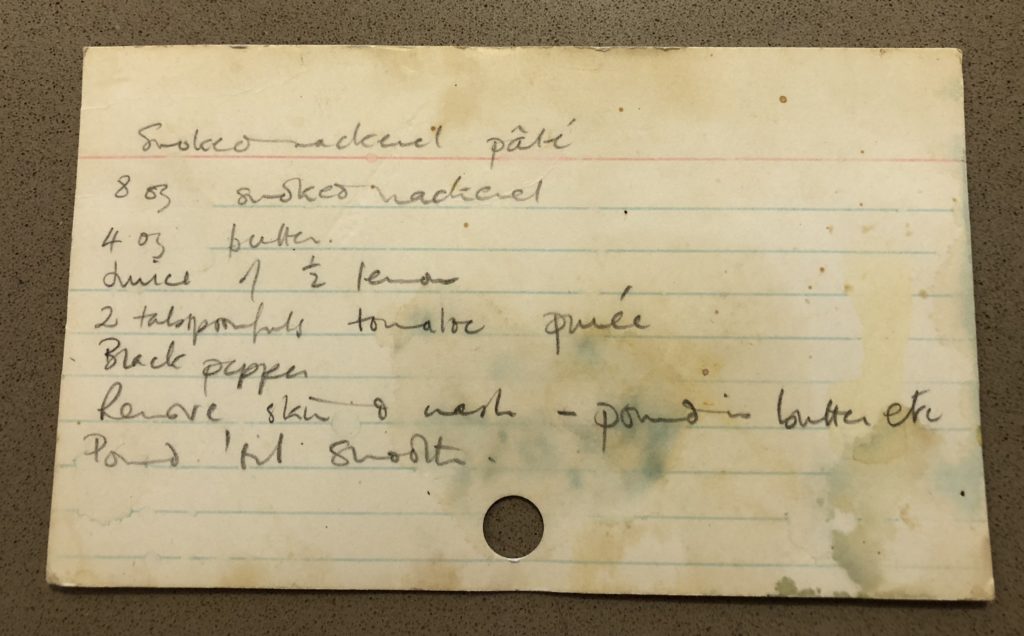
Lesley Handford’s Mackerel Pâté

Dracula

“There are many odd things to put down, and, lest who reads them may fancy that I dined too well before I left Bistritz, let me put down my dinner exactly. I dined on what they called “robber steak”- bits of bacon, onion, and beef, seasoned with red pepper, and strung on sticks, and roasted over the fire, in simple style of the London cat’s meat!”

Manuela Farmer’s Elder Blossom Wine & Golden Oil

In 1896 a good book was published, called “Farmers Manual”

Inside, two handwritten recipes were found. Transcribed as seen:

Elder Blossom Wine  Pick the Blossoms from
the Stems  Take one “quart of Blossoms to one
gallon of water  heat the Water Boiling  then
Pour it on the Blossoms  Let it Stand one
Hour  Strain  then add three Pounds of Shugar
then a little  so the Sugar Disolves  Let it
come to a boil  and Skim after it cools of
a Little  then add ‘one Lemmon  one table
Spoonful of hops yeast  then let it Stand
twenty four hours  and Strain and *u
dont cor* to (l)ight for a few days
and Keep in a cool place  you can grate
the Lemmon as Slice it to get the Strentt
out of  to

Receip(t)t for Golden Oil

I Quart of Linseed Oil
I Oz Hemlock Oil
I Oz Cedar Oil
I Oz Sasafras Oil
I Oz Organum Oil
I Oz Camphor Gum
1/4 Oil of Spike

(*) = unreadable

Sharmilar Devar’s Pruno

There is no exact science to Pruno, aka Prison Wine – to my knowledge. I learned about it from a 2-Striker who was very interested in imparting helpful information to me.

For example, NEVER punch a police officer’s horse, as that will be considered Assault on a Police Officer (and you will get the appropriate punishment). Also, he shared the best places on your body to “shoot up” your drug of choice so as to evade detection from the authorities… or your significant other – in custody and on “the outside”.

Also, if a person with any sort of record goes to rob a 7-Eleven with a person with no record, and that (no-record) person is shot by a police officer & killed, it is probable that the record-holding thief with be hit with a murder charge, so the police will come off scott-free.

2-Striker might have been high when he told me the last one… but I’m pretty sure the other two are true.

As is this very imperfect recipe for Pruno.

Basically, Pruno is alcohol made from whatever you get during your meals in prison or jail. Usually you collect the fresh fruit you get, whether an apple or orange – even a banana will do. You will need to chew it so that the juices are flowing. Then, you add the bread from any sandwiches that you are given. As there isn’t a lot of food given in each prison meal & you are often hungry, this particular 2-Striker told me that he would eat his sandwiches, but save the crusts of the bread for his Pruno. I would imagine you can tweak the flavors based on items used and the amounts.

Please find the recipe below. I haven’t tried it, but if you do – please let me know if it works!

PRUNO (California Style)

* 1/2 eaten (chewed up to the best of your ability) fresh fruit (apple/orange/banana) – whatever you get in prison/jail
* the crusts of bread from your prison sandwich
* water or juice

NOTE: Saliva is a very important component to this recipe. DO NOT REPLACE!

OPTIONAL:
* sugar packet
* jelly packet
* maple syrup packet
* cookie
* any non-chocolate candy, like sweet tarts, skittles, etc. (if you can get these from Commissary – or whatever way one gets such treats in prison/jail)

Once you have been given your fruit of the meal, start chewing it up into small, half-digested pieces. Your saliva will help you greatly with this recipe – it is a necessary component.

Set the chewed up fruit aside. Try to keep as much of the liquid created as possible.

Then take any sandwich you have been given for the day. Save as much of the bread as you can. If you are too hungry, eat the sandwich and save the crusts of the bread. (Please understand that it might take you longer to create Pruno with less bread AKA less yeast source.)

Chew the bread pieces until suitably salivated (soggy and chewed up).

Add chewed up bread to chewed up fruit and set aside.

Find a container – whether a sock or something fashioned from a undershirt, underwear, whatever you have laying around. If using cloth, you will need to layer it as much as possible, so as not to lose the precious Pruno Starter.

Stuff the chewed up fruit and chewed up bread into the receptacle. Add water, or if you have it, juice. At this time, you can add any additional items, such as the sugar, jelly or maple syrup. If you choose to add a cookie or candy, please make sure it is chewed up as this is the best way to release the sugars.

Close the receptacle as tightly as possible. Combine the ingredients via shaking, squishing, etc.

Place in a dark safe place. 2-Striker suggested the toilet as, in his experience, this made the best Pruno and was the safest place for it to evade the prison guards.

Continue to add additional fruit, bread, optional items, water as your starter begins to ferment.

Depending on prison temperature and ingredients, I would imagine your Pruno could be ready for consumption in as soon as a week. Although, if you choose to wait longer, I think (based on my limited scientific knowledge) that your Pruno will become stronger with a higher alcohol content.

I assume you can add water to dilute the mixture if you choose to share it with others.

*** PLEASE NOTE:

re: Toilet Placement – I do not know if urine is a component in this recipe! I assumed that 2-Striker took out the Pruno Starter when he or his roommate used the toilet. Or at least angled their urination away from the Pruno.

Unfortunately, I did not get this part clarified when I was given the original recipe.

Enjoy!!!

Sandra Jasper’s Vegan Cheesecake

Ingredients
For the base:
130g walnuts or almonds
75g dates
1 tablespoon of water
1 teaspoon of cinnamon powder

For the filling:
200g cashews (leave soaking in water overnight the previous night)
juice of 2 lemons
70g agave syrup
75g coconut oil
60 ml water
a pinch of salt
vanilla

tools:
blender
7 inch (18 cm) ring tin

Steps:
1. Put the ingredients for the base (walnuts, dates, water and cinnamon) in the blender, and mix until sticky.
2. Spread base mix equally on the bottom of the ring tin.
3. Put the ingredients for the filling (cashews drained of water, lemon juice, agave syrup, coconut oil, water, salt, and vanilla) in the blender and mix until smooth.
4. Spread the filling on top of the base.
5. Put the tin in the fridge for 2 hours – ready.
6. If you don’t eat the whole cake at a time, you can put it in the freezer and take it out an hour before you’d like to eat it.
7. Add raspberry sauce, if you like.

Paul Novak’s Gluten-free Yeast Bread/Rolls

Boil 1/2 pound of potatoes for 25 minutes; rice or mash. Save potato water

2 T yeast in 1 C warm milk or water (could be saved potato water); let this sit before adding
1 t cider vinegar
2 T unsweetened applesauce
2 large eggs

1/3 C dry milk (or dry buttermilk powder)
1/2 t salt
2 T sugar
3/4 t each baking powder & baking soda
1/2 t lecithin
2 t xanthum gum
1 t guar gum

3/4 C sorghum flour (or other gluten-free flours: millet, buckwheat, potato, etc.; but not rice: too bland)
3/4 C potato starch
1/2 C tapioca flour
1/4 C corn flour (not meal)
1/4 C almond flour
1/2 C sweet rice flour

Mix, put in bread pan; let rise about an hour. Bake in 375º F oven for 50 to 60 minutes

OR make 8 rolls, let rise on pan for 45 minutes and bake in 375º F oven for 25-35 minutes

And these thickeners are roughly equivalent: potato starch, cornstarch, tapioca flour, sweet rice flour. In a pinch, potato flour can be substituted for SOME of the potato starch.

Try other cooked grains as a substitute for the riced potatoes. E.g., 1/2 C sorghum grain in 1 C water cooked for 60-65 minutes covered OR 1/2 C gluten-free rolled oats in 1 C water cooked for 10 minutes uncovered OR….

Copyright 2017 by Paul M. Novak

Hannah Cull’s Muhummara (roasted red pepper & walnut dip)

3 red peppers
50g fresh breadcrumbs
a handful of walnuts
2/3 cloves of garlic
Squeeze of lemon juice
1 dried red chilli
1 teaspoon ground cumin
2(ish) tablespoons pomegranate molasses
2 (ish) tablespoons extra virgin olive oil

Heat the oven to 200C. Put the peppers on a tray and roast for 30-35 minutes, turning occasionally, until they are cooked and the skin is blackened. Put the peppers in a bowl, cover with cling-film and, once cool enough to handle, peel and discard the skin and seeds.  Put the peppers in a food processor, add the breadcrumbs, lemon juice, molasses, cumin, chilli and garlic.

Stir through the walnuts, a quarter-teaspoon of salt and the olive oil. Add more pomegranate molasses and salt to taste.

Enjoy!

Margery Kempe (c. 1373-1440)

‘Sugar with aniseed, fennel seed, nutmeg, cinnamon, ginger [to make the] confection and to [then] beat them together in a mortar and heat them in the manner of food and drinks and dry first and last eat.’

Dave Knapik’s Calpisoco Cocktail

A cocktail of borne of Christmas desperation and a resourceful spirit(s):

1 part Southern Comfort
3 or 4 parts Calpis (or Calpico depending on your location)

Alternatively, just pour an amount of Southern Comfort into a glass that doesn’t make you feel too shameful, then add an appropriate amount of Calpis to taste.

かんぱい!

Marjolein’s Leak Soup

Wash 3 leaks and cut into chunks after removing the dark green

2 handfuls of oat flakes
Optional sprinkle of aniseed seeds or basil to your taste
Pepper and salt
Water or bouillon

Boil

Cook on a low heat for 30 minutes

Blend the mixture then sieve to remove remaining debris

Serve with a dollop of sour cream

David Jackson’s Smoothie of the Day

some milk, mixed seeds, spinach, walnuts, EVOO, banana, dates, some sea salt…

Oren Ambarchi’s 2 x sumptuous fish recipes from the Ambarchi kitchen both derived from traditional Sephardic recipes that go way back

POISSON SAUCE ROUGE

Ingredients:

Flour
3 Red Peppers
2-3 Cloves of garlic, peeled
1kg (2lb) of white fish fillets such as Flathead or Snapper
4 tablespoons of Peanut Oil
Juice of 1 Lemon
Mediterranean Parsley
Salt & Pepper

1. Roast the red peppers in a hot oven (about 200-220 degrees) – make sure
they’re fleshy – put them on a baking tray in the oven until their skins are
blistered & black. Turn them over once so the skins are blistered on both
sides. Take them out and leave for 10-15mins.
Once they are cool enough to handle, peel them and remove the seeds & stem. Keep
the juice but make sure there are no seeds in it.
2. Blend the peppers and the juice of the peppers to a cream together with the
garlic + the salt & pepper in a food processor
3. Pour the sauce into a pan & heat through being careful not to burn it. Heat
it through gently until it begins to bubble.
4. Lightly flour the fish & then saute in the oil turning over once
5. Take the fish out & add a little salt & pepper + the lemon juice
6. Serve with the sauce poured over the fish and the chopped parsley sprinkled
on top

Best served with cous cous & a Mediterranean green salad (tomatoes, cucumbers,
parsley, a little mint, lemon juice, olive oil, salt & pepper).

POISSON AUX CITRONS CONFITS

1.5kgs (3lb) of White FIsh Steaks or Fillets such as Flathead or Snapper
3 Preserved Lemons (these are lemons that have been preserved in salt – easy to
make but even easier to buy readymade in a jar from a store)
4 Tablespoons of Peanut Oil
175ml of Water
1 Teaspoon of Smoked Paprika (or regular paprika, however the smoked version is
goooood)
1/4 Teaspoon of Turmeric
Salt + Pepper
4 Tablespoons of chopped Coriander

1. Mix and beat the oil and water with the paprika, turmeric, salt, pepper and
chopped coriander and marinate the fish in it for 30mins
2. Rinse the preserved lemons under cold water & remove the pulp (important!).
Once the skins are rinsed cut them into small pieces & spread half of them on
the bottom of a baking dish
3. Lay the fish on top and pour the marinade over it
4. Cover with the remaining lemon skins
5. Bake in the oven at 220 degrees for 20mins

As per the previous dish this one is best served with cous cous & a
Mediterranean green salad (tomatoes, cucumbers, parsley, a little mint, lemon
juice, olive oil, salt & pepper).

Bon Appetit!

Ian R. MacLeod’s Flying Saucer Pie

Like many good recipes, this one comes vaguely remembered from a book which is now lost. I reckon the book was probably eaten by the dog; of course, this is also always a sign of quality, as only the best recipe books get enough food splattered on them to become truly attractive to canines. The recipe itself is a cheat, in that it involves putting together a few cheapish and easily obtainable shop-bought things in such a way as to give the impression of many hours of intense labour in a hot kitchen. To my mind, this, again, is no bad thing. The name comes from my daughter’s Emily’s description of what it looks like when finished. If you try it, you’ll soon see what I mean.

500 g packet of puff pastry
500 g of minced beef (or whatever other meat or non-meat takes your fancy)
100 g (ish) packet of sage and onion stuffing mix (or, again, whatever else.)
A large glass of red wine (you can use white for lighter meats)
An egg, lightly whisked.

Thaw and roll out and then cut the puff pastry into two circles, one a little larger than the other. The younger of you will be aiming for diameter of 20 and 25 cm – the older for something like a vinyl LP. Mix the meat and the puff pasty and the wine in a bowl. The rest of the wine in the bottle can, of course, be thrown away. Place the smaller of the two pastry circles on a flat, greased baking pan. Then put that mixture, looking pretty much like an upturned bowl, centrally on the circle, leaving about 2 cm around the edge. Brush the edge with the egg mix, place the bigger pastry circle on top, use a fork to make a pretty pattern where they join, then cut a couple of slots to let the air escape from the top. Trim off any bits which offend artistic sensibilities regarding the circularness of your circle. Use the rest of the egg to glaze the pie (which should by now be looking like a flying saucer unless something has gone seriously wrong) and place in the oven for about an hour and ten mins at gas mark 5 or about 190 centigrade. Make sure it’s good and brown and well cooked and, uh, eat it, although you might like to wait about 20 mins for it to set and cool.

The pie is actually one of those rare things that works even better after a day or so left cold.

www.ianrmacleod.com

Michael Esposito’s Mormon Funeral Potatoes

There are many versions of Funeral Potatoes. Some recipes call for putting cheese (about 1 cup of Cheddar, American or whatever you like) in the potato mixture and using buttered bread crumbs for the topping.

1 1/2 lbs frozen hash brown potatoes, preferrably southern-style diced ones
1 (10 3/4 oz) can condensed cream of celery soup (or cream soup of your choice)
1 (10 3/4 oz) can condensed cream of potato soup
3/4 cup milk
1 pint sour cream
Grated parmesan cheese and butter for topping

Heat over to 350 degrees F.

Mix all the ingredients except cheese and butter, and pour into a shallow baking dish. Top generously with cheese and dot with bits of butter. Bake for 45 to 60 minutes or until bubbly and cheese is lightly browned.

Makes 6 to 8 servings.

Bureau of Prisons Inmate #26854-112’s Recipes for Hard Times

Penitentiary’s follow a weekly meal plan. Without exception, inmates are served the same meals on a rotating basis each week for the duration of their sentence. Many choose to prepare their own meals in their cell blocks or units. The following are some favorite foods enjoyed by guest of the state. Recipes vary, but these are generally dishes meant to be prepared either in cells or common areas of the penitentiary & without the benefits of the common kitchen.

Some foods are prepared & shared amongst friends, others are offered up for sale on the black market. Religious groups with dietary restrictions tend to prepare their own meals together, for instance.
Prison Bowls

Most inmates own a tupperware container & plastic flatware set purchased from the prison commissary. Three to ten individuals will regularly contribute towards an evening meal which is made in one large container & then served up into individual servings & delivered in their ‘bowl’. Inmates working in the prison kitchen will secretly abscond with fresh ingredients that make their way into these meals via the black market, while items such as tortillas, crisps, crackers, tuna fish & other canned meats may be purchased from the prison commissary. A common bowl will consist of one layer of refried beans, one layer of rice, one layer of nacho cheese sauce, one layer of meat & one layer of tortilla chips on the top, sometimes with tortillas between each layer.

Frito Tamale

A bag of frito or other corn chips is crushed into meal, and a small amount of hot water is added. The mixture pressed & left to cool. Once cooled a seasoned & cooked beef mixture may be wrapped in the corn meal as one would a traditional tamale. With corn husks generally not being found in most prison cell blocks, these are generally wrapped in either sandwich bags, plastic wrap or newspaper. Individual tamales will be sold for between 2 & 4 stamps each, depending on quality.