










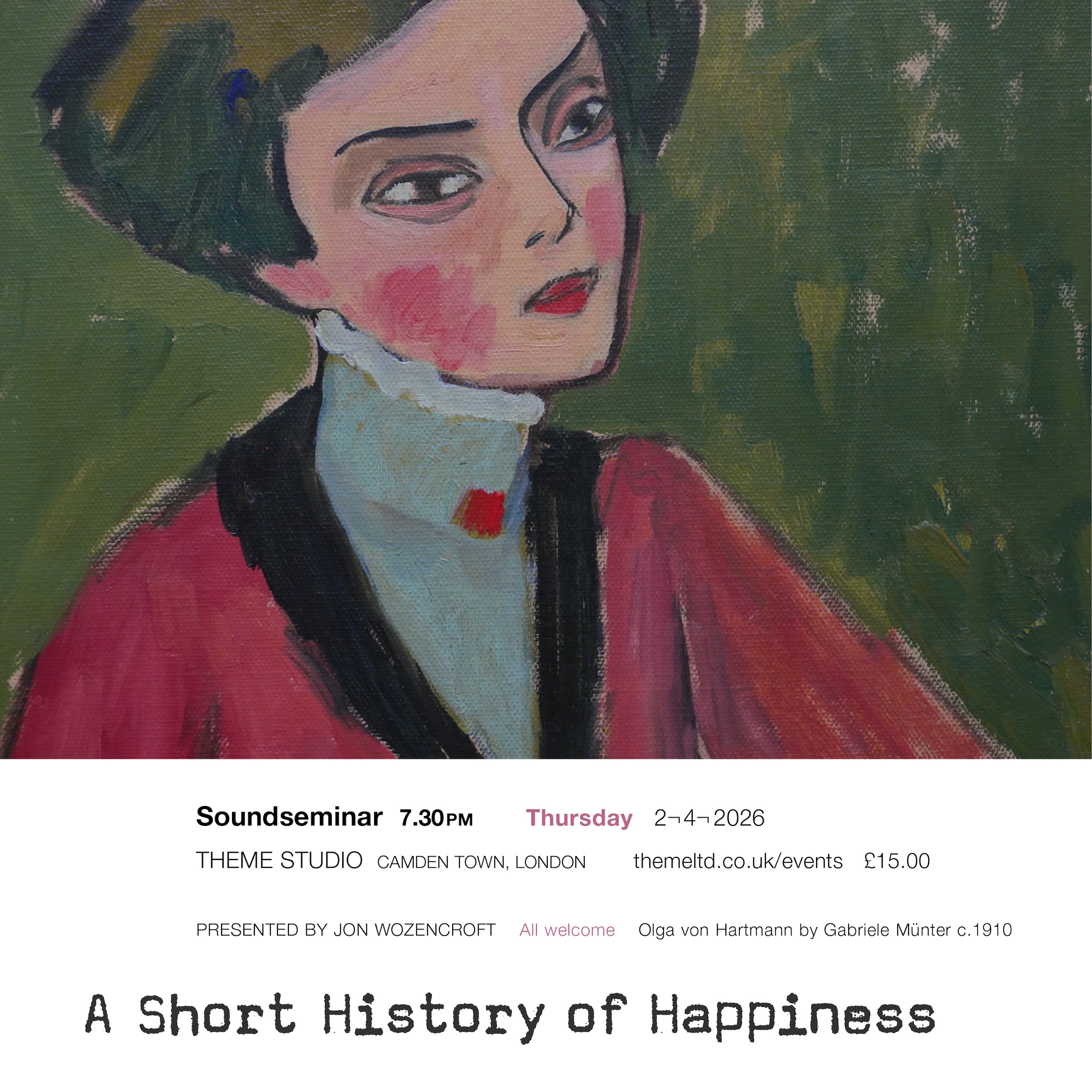
A Short History of Happiness
The big unanswerable question – how do you measure happiness? What does happiness mean? Is it simply a perception of one’s self which is beyond verification? In this sense it is close to the mystery of consciousness, personal and beyond digital – and AI algorithms, for the time being at least. Can ChatGBT make you happy? It will sure try and convince you that it can.
Is it to do with one’s personal experience of pleasure, of contentment? Good food and good sex? Pure luck in the scheme of the way life pans out? Being well off? Well not that, obviously, because there are plenty of examples of the filthy rich who are avowedly unhappy, hiding bigger problems with their steady accumulation of more and more. Sexual pleasure seems to be way down the list of people’s experience and priorities right now. Falling birth rates just one indicator of this global anxiety. Libido, desire, tactility, all under fire.
Happiness needs a collective energy. I don’t think it’s easy to be happy if not many other people share the spirit of what’s in the air. Is it primarily about human, personal relationships and how one weathers all the challenges of intimacy between the home and the world? – this, maybe.
Can we still say that the quest for happiness is the prime motor behind perception, feeling and behaviour? Or just give up?
The question of happiness is not bound first and foremost by privilege and money, though obviously that helps considerably. Happiness has its history over centuries but there is no way of knowing what was what, and when or where. This painting by Gabrielle Münter was part of Kandinsky’s “Blue Rider” project from 1912/13. Did they know that WW1 was imminent? Perhaps, perhaps not. The subject – Olga von Hartmann – was the wife of Thomas, a composer and close collaborator with Kandinsky and later, Gurdjieff.
Shortly after, in 1916, history might find happiness in the exuberance and daring of Dada. Things are so fucked up in the world, just do whatever you want. Cut it all up. Over 100 years later, there has to be another way for us to break the castle of abstraction caused by living with this spectre of increasing automation and constant surveillance. To not resort to violence… instead, the instinct could be, withdraw, regroup and think afresh.
In July 2011 the United Nations General Assembly voted for a happiness index to be created. The World Happiness Report this last year, 2025, has Finland at number one, which is curious given the cold climate and the reportedly high suicide rates. Following Covid lockdowns, the Hikikomori phenomenon in Japan presents an earlier extreme response to the pressures of everyday life – over a million people (predominantly young males) choose to isolate themselves in their homes, only opening their doors for food deliveries and using their internet connections as their one window to the outside world.
“Turn on, tune in, drop out”. Timothy Leary, 1967. (We need an upgrade of psychedelia, the anti-retro version). Not “Turn off, tune out, drop out”. The 2026 remix. Isolation is not the answer.
Happiness is not a warm gun.
Reading:
Franco Berardi, Quit Everything – Interpreting Depression
Dario Amodei – The Adolescence of Technology: Confronting and Overcoming the Risks of Powerful A!
Tamaki Saito – Social Hikikomori: Adolescence Without End